

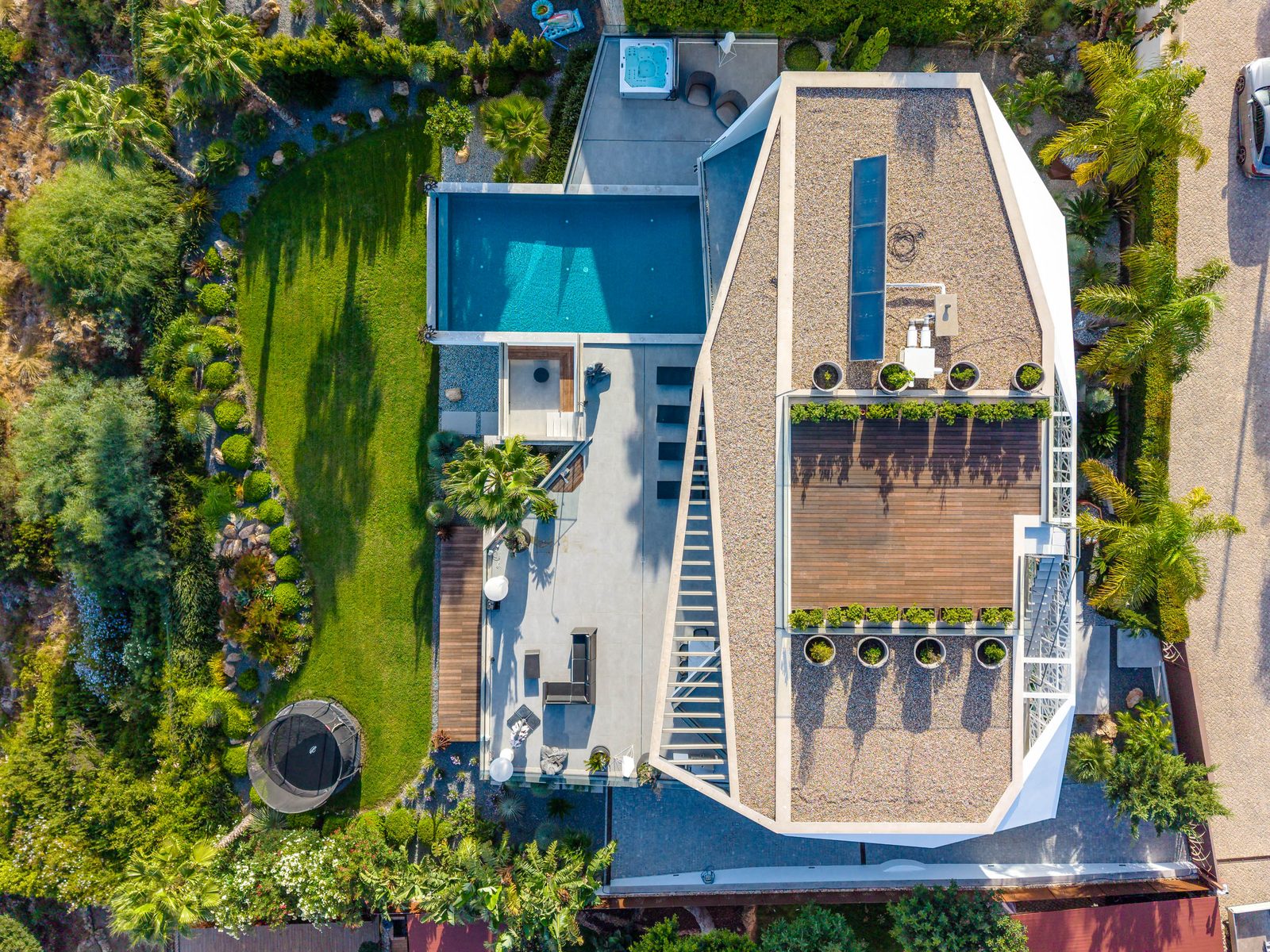
The Western Algarve has one of the sunniest climates in Europe, and that fact has slowly worked its way into how owners think about their homes. Across Lagos, Meia Praia, Praia da Luz, Burgau and the villages towards Vila do Bispo and Sagres, solar panels have become a common sight on roofs and terraces. For anyone weighing a villa or an apartment here, understanding how self consumption works helps separate a genuinely useful upgrade from an expensive distraction.
Portugal regulates home generation through a self consumption framework, known locally as autoconsumo. The principle is simple. A household generates electricity for its own use, draws from the grid when the panels are not producing, and in many cases feeds any surplus back. B&P Real Estate notes that the appeal along this coast rests on long, bright summers and shoulder seasons that keep panels working well into the autumn.
How the rules work
The paperwork depends on the size of the installation, and for most homes it stays light. The broad structure runs along these lines.
- Very small systems, now up to around 800 watts, need no prior control provided no surplus is sent to the grid, with that threshold having risen from 700 watts
- Systems above that figure and up to 30 kilowatts need only a prior communication to the authorities
- Larger installations, from 30 kilowatts upwards, move into registration and certification
A typical family villa sits comfortably within the prior communication band, so the administrative burden is modest. Registration runs through the Direção-Geral de Energia e Geologia, and an installer will usually complete it on the owner's behalf. A metering device becomes a requirement once a system passes 4 kilowatts, so it is worth confirming what is included in any quote.
Selling surplus and the numbers
Electricity that a home does not use can be sold, though only under a contract with an authorised buyer, or it can be fed to the grid without payment where the rules allow. Income from selling surplus from a small home system is excluded from income tax up to €1,000 a year, which keeps the arrangement straightforward for most households rather than turning it into a business.
On cost, buyers should budget for VAT in full. The temporary reduced rate of 6 per cent on solar panels and their installation lapsed on 30 June 2025, so the standard 23 per cent rate now applies. There is no dedicated income tax deduction for home panels, although some municipalities offer a reduction on the annual property tax for energy efficient homes, which is worth checking with the local câmara. National grant calls through the environmental fund open and close with limited budgets, so they cannot be counted on.
Payback depends on the system, the home and how much power is used during daylight hours. With Algarve sunshine and household electricity prices well above many northern markets, a well sized array on a family home often pays for itself over several years. Those figures are the agency's general observation rather than a promise, and a shaded roof or an awkward orientation can change the picture, so a proper site assessment matters.
The value of a system also turns on how much of the generation a household actually uses on site. A home that is occupied through the day, or that runs a pool pump and air conditioning when the sun is strongest, captures far more of the benefit than one left empty for long stretches. Battery storage can shift some daytime generation into the evening, although it adds cost and does not suit every budget, so many owners start without it and add storage later if their usage justifies it. For a holiday home used mainly in summer, the seasonal pattern of occupation is worth weighing against the outlay before committing.
Villas and apartments differ
A detached villa is the simplest case, because the owner controls the roof and can size a system around the pool pump, the air conditioning and the daily load. This suits buyers drawn to luxury villas Algarve, where panels are often already fitted, and it is sensible to ask for the installation records and any existing registration before completion.
Apartments are more involved, since the roof is usually common property. Fitting panels there needs the agreement of the condominium, and recent changes have eased that by allowing approval through a simple majority at the owners' assembly rather than full agreement. Anyone looking at Algarve apartments for sale in a block should ask whether the building already has shared solar, or whether it permits individual installations on the roof or a terrace.
What it means for value
Energy performance has become part of how homes are judged, and a solar installation can lift a property's energy rating as well as cut bills. That carries weight at resale, since buyers now read the energy certificate with more attention than they once did. On underlying values, Idealista put Lagos near €3,900 per square metre in mid 2024, and prices across the Western Algarve have firmed since, with B&P Real Estate reading typical Lagos stock in the mid €4,000s per square metre in 2026. That is the agency's own reading rather than a formal valuation, and sub market figures vary by location, aspect and condition.
Summary
Solar makes sense in a climate like this one, and the rules for a normal home are lighter than many buyers assume. A villa owner can act alone, and an apartment owner works through the condominium, while the standard 23 per cent VAT now applies to the panels and their installation. The sensible first step on any purchase is to check what is already installed and whether it has been properly registered.
B&P Real Estate helps buyers across Lagos, Praia da Luz, Burgau, Vila do Bispo and the western coast find homes that suit the way they want to live, solar panels and all.
